
Senior event strategy and operations consulting
Event Strategy & Operations Consulting
Bring RWK in when accessibility is one part of a larger event operating challenge—and the scope, ownership, vendors, venue, budget, decisions, or live delivery need stronger structure.
This work is designed for complex conferences, summits, executive convenings, association programs, nonprofit gatherings, and high-visibility events where weak handoffs create real operational consequence.
When the room fills, structure becomes visible.
$260K+
Protected and negotiated value across complex event environments.
40%
Reduction in manual workload through stronger systems and ownership clarity.
400+
Programs governed or executed across the career.
5–6
National convenings supported annually in recurring planning cycles.
What this actually means
This is the disciplined event operations work that happens before contracts are signed, budgets are announced, vendors are locked, accessibility needs are pushed downstream, and public visibility increases.
I help organizations clarify scope, identify exposure, align governance lanes, and build accessibility into the event structure before decisions become expensive to reverse.
This is where accessibility, budget, vendors, venue reality, and decision authority are treated as risk infrastructure, not separate planning conversations.
The goal is not just a good event plan. The goal is an event environment that can actually hold under pressure.
That protects credibility, financial stability, access, stakeholder trust, and internal alignment before momentum makes correction harder than it needs to be.
Where this support matters most
Most organizations arrive here when the event still looks manageable from the outside, but the structural questions underneath it are not fully settled.
Scope is growing, but exposure has not been mapped. Budget decisions are moving, but operational consequence has not been fully accounted for. Accessibility may be on the checklist, but not yet embedded in the design.
This is the stage where stronger event architecture saves money, protects reputation, and prevents downstream correction from becoming the entire job.
Event Environment Architecture™
This framework illustrates the structural forces that shape high-stakes event environments long before attendees arrive.
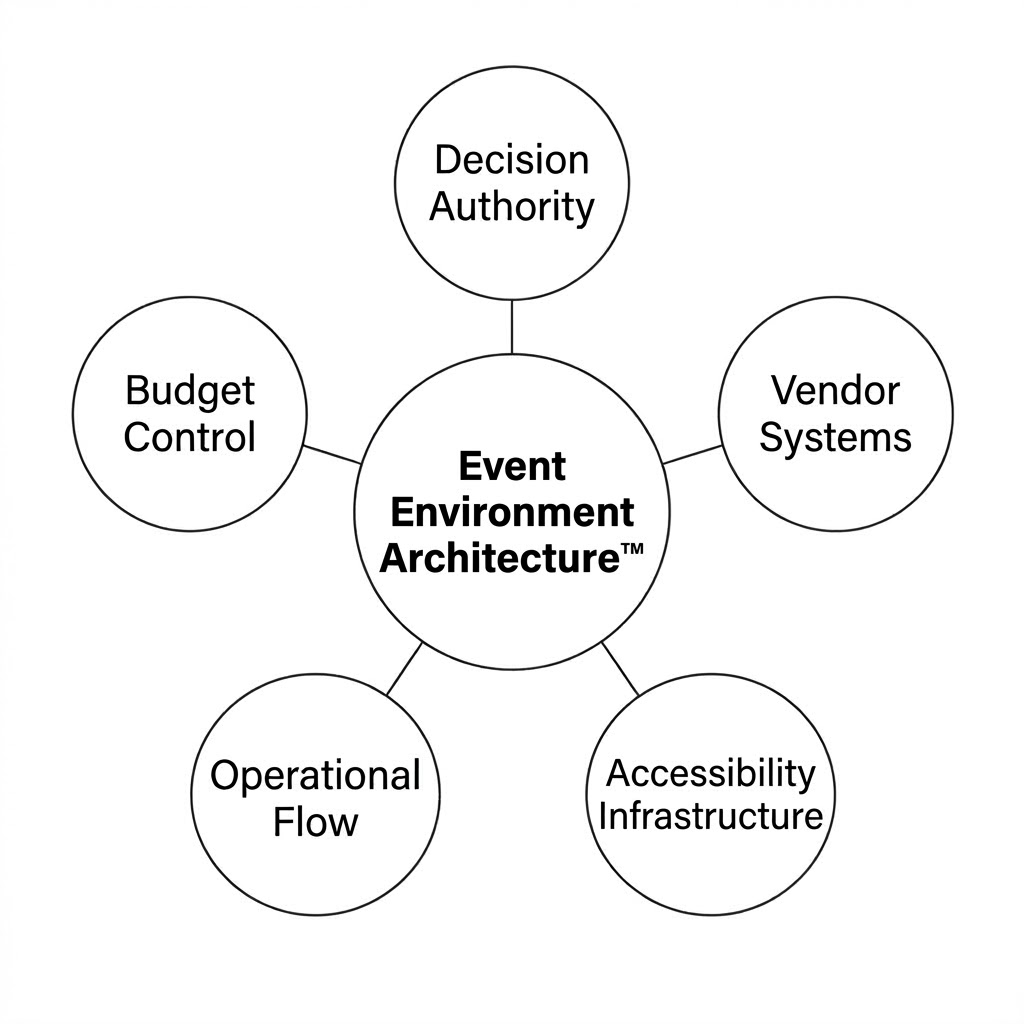
The point is simple. Event environments do not become unstable by accident. They become unstable when governance, access, budget, vendor strategy, venue reality, and operational execution are treated like separate conversations instead of one shared structure.
What Event Strategy & Operations Consulting includes
Scope and Exposure Mapping
Program scope definition and exposure mapping so the plan reflects what is actually being asked of the event environment.
Budget and Operational Reality
Budget framework design that accounts for operational reality instead of leaving correction to the back end.
Decision & Ownership Alignment
Decision rights, approval pathways, and ownership clarity before timelines tighten.
Accessibility Infrastructure
Accessibility strategy and infrastructure so participation is designed into registration, venue flow, communication, digital access, meals, mobility, and onsite operations.
Vendor and Venue Strategy
Vendor and venue strategy that supports the event you are actually building, not just the version that looked fine on paper.
Risk Anticipation
Pressure-point identification before operational, reputational, financial, access, or human consequences surface publicly.
What changes when this is done well
The plan gets clearer before execution gets noisy.
Leadership knows what is actually at stake.
Accessibility is accounted for as infrastructure, not surprise labor.
Vendors work inside stronger boundaries.
The event environment has a better chance of holding because the structure was built to support what the room will ask of it.
What you leave with
The exact deliverables depend on scope, but the work is designed to leave leadership with clearer decisions, stronger boundaries, and an event structure that can be governed after the engagement ends.
A clearer event architecture
Defined scope, planning logic, ownership, decision pathways, and exposure visibility.
A stronger risk picture
Named operational, financial, access, vendor, venue, and capacity risks before they become correction work.
Actionable planning infrastructure
Recommendations, frameworks, or planning artifacts that match the engagement and support implementation.
A contained next move
Clarity about what should proceed, what needs reinforcement, and what should not be carried forward without correction.
Is accessibility itself the primary question?
When the core need is accessibility readiness, procurement, destination ecosystem review, supplier capability, or education for event teams, use the dedicated Accessibility Operations & Strategy lane rather than broad event architecture.
Begin with strategic clarity
If you need to think through the structure before larger decisions lock, start with a 15-minute RWK Fit Call.
If the need includes accessibility-specific ownership, handoffs, vendor requirements, verification, or participant access, begin with Accessibility Operations & Strategy.